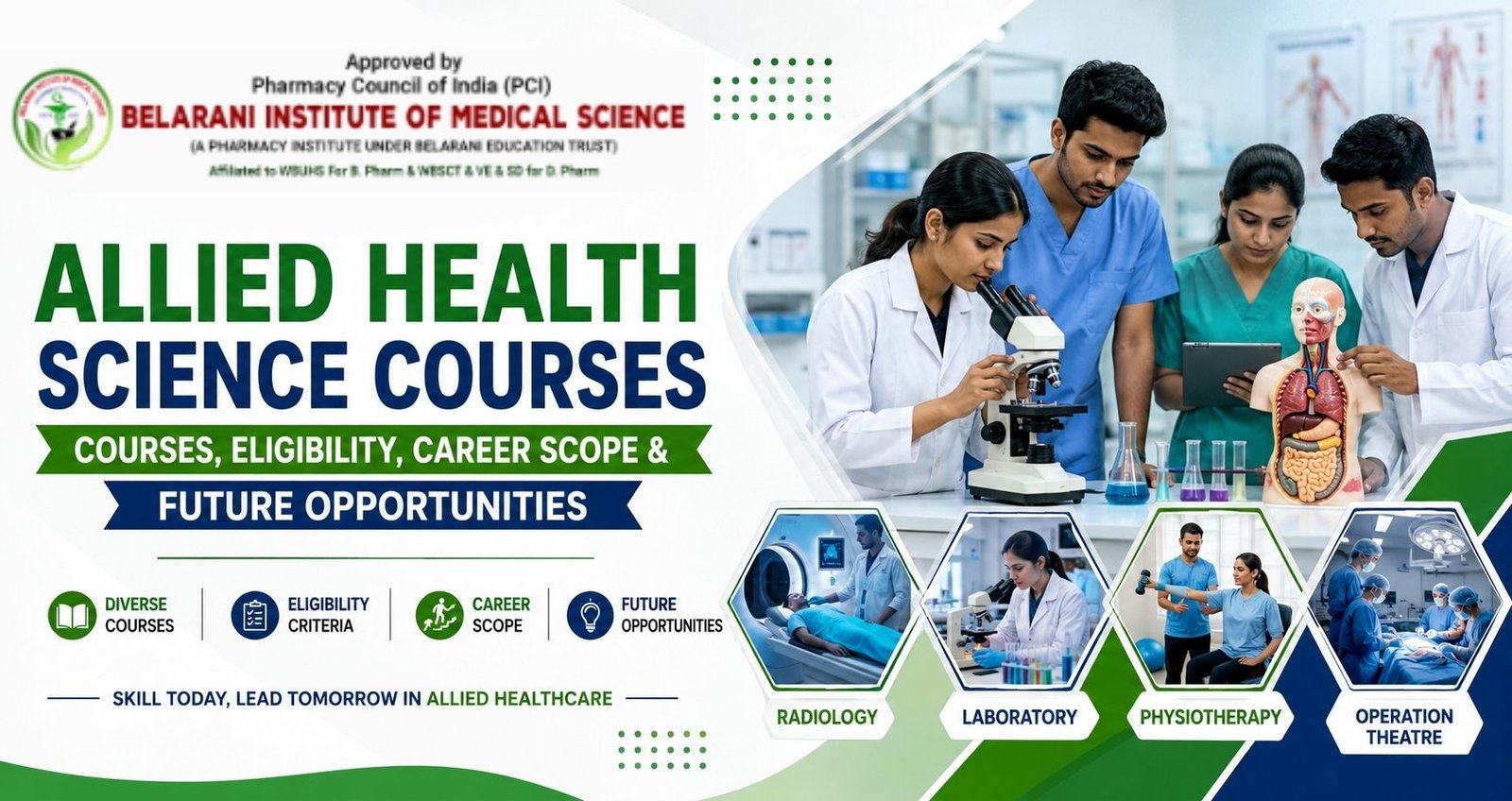
Healthcare is no longer limited to doctors and nurses. Behind every accurate diagnosis, successful operation, laboratory report, imaging scan, rehabilitation plan, and emergency service, skilled allied health professionals play an essential role. This has made allied health science courses an attractive choice for students who want a healthcare career after Class 12.
Allied health programmes combine medical knowledge, technology, practical training, and patient support. Depending on the specialisation, students can build careers in hospitals, diagnostic laboratories, imaging centres, rehabilitation facilities, emergency units, research organisations, and healthcare settings.
What Are Allied Health Science Courses?
Allied health science courses prepare students for specialised healthcare roles that support diagnosis, treatment, rehabilitation, prevention, and patient care. These professionals work in multidisciplinary healthcare teams.
The field includes undergraduate, diploma, and certificate-level programmes. Bachelor’s programmes commonly take around three to four years, depending on the specialisation and institution, and may include practical training or internships.
Top Allied Health Science Courses After 12th
Popular allied health science courses include:
- Medical Laboratory Technology: Focuses on laboratory testing, sample handling, pathology, microbiology, biochemistry, and diagnostic procedures.
- Radiology and Imaging Technology: Trains students to work with diagnostic imaging procedures and equipment used in healthcare.
- Operation Theatre Technology: Covers operation theatre preparation, surgical assistance, sterilisation, equipment handling, and patient safety.
- Dialysis Technology: Prepares students to support dialysis procedures and care for patients receiving renal replacement therapy.
- Cardiac Care Technology: Focuses on cardiovascular investigations, monitoring, and technical support in cardiac care settings.
- Optometry: Develops knowledge and practical skills related to vision assessment, optical care, and eye health services.
- Respiratory Therapy: Covers respiratory assessment, monitoring, and supportive care for patients with breathing-related conditions.
- Physiotherapy: Focuses on movement, rehabilitation, exercise therapy, functional recovery, and physical wellbeing.
- Emergency and Critical Care Technology: Prepares students for technical and supportive roles in emergency and critical-care environments.
Eligibility for Allied Health Science Courses
Eligibility depends on the specific programme and institution. For many undergraduate allied health courses, students are expected to complete Class 12 with Science subjects, particularly Physics, Chemistry, and Biology. Some programmes may accept Mathematics or have different subject combinations.
Minimum marks, age requirements, entrance examinations, and admission procedures can vary. Students should check the latest criteria issued by the college before applying.
How to Choose the Right Allied Health Course?
Choosing a course only because it is popular may not lead to the best outcome. Start by identifying the type of work you enjoy. If you like laboratory investigation, Medical Laboratory Technology may be suitable. Students interested in medical equipment and imaging can consider Radiology. Those attracted to surgical environments may explore Operation Theatre Technology.
Also consider course duration, practical exposure, internship opportunities, curriculum, faculty, laboratory facilities, hospital tie-ups, recognition or regulatory requirements, fees, and future study options. Practical learning helps develop job-ready skills.
Why Choose Allied Health Science Courses?
One major advantage is the variety of career pathways. Students can enter specialised healthcare roles without following the traditional MBBS route. The courses are also strongly connected with practical healthcare services, allowing students to develop technical and professional skills.
Growing hospitals, diagnostic centres, specialised clinics, rehabilitation services, and healthcare technology are creating opportunities for trained professionals.
Career Scope After Allied Health Science Courses
Career opportunities depend on the qualification and specialisation. Graduates may work as medical laboratory technologists, radiology technologists, operation theatre technologists, dialysis technologists, cardiac care professionals, optometrists, physiotherapy professionals, respiratory therapy professionals, or emergency-care technicians.
Employment opportunities can be found in hospitals, diagnostic laboratories, imaging centres, rehabilitation centres, nursing homes, research facilities, healthcare companies, and specialised clinics. With experience and additional qualifications, professionals may move into senior technical, supervisory, teaching, research, or administrative roles.
Government and Private Sector Opportunities
Allied health professionals can explore both public and private healthcare sectors. Government hospitals, medical colleges, health departments, diagnostic facilities, and public healthcare programmes may offer relevant positions depending on recruitment rules and vacancies.
Private hospitals, diagnostic chains, specialty centres, rehabilitation facilities, and healthcare organisations also require trained allied professionals. Students should understand that job availability, designation, salary, and registration requirements differ according to the profession, state, employer, and qualification.
Higher Studies After Allied Health Courses
Depending on the discipline and eligibility, students can pursue postgraduate degrees, specialised certifications, healthcare management programmes, public health studies, research, or academic pathways.
Higher education can help professionals develop expertise and qualify for advanced responsibilities. Students interested in teaching or research should select postgraduate programmes aligned with their undergraduate specialisation.
Skills Needed for a Successful Allied Health Career
Technical knowledge is only one part of professional success. Allied health professionals need attention to detail, communication skills, teamwork, ethical awareness, patient sensitivity, time management, and the ability to work calmly in demanding situations.
Because many roles involve diagnostic equipment, clinical procedures, or sensitive patient information, accuracy and responsibility are particularly important. Practical training, internships, workshops, and supervised clinical exposure can help students develop confidence before entering the workplace.
Is Allied Health Science a Good Career Choice?
For students interested in healthcare but looking for specialised alternatives to conventional medical careers, allied health sciences can be a promising option. The sector offers multiple disciplines, practical learning, diverse workplaces, and opportunities for continued professional development.
However, students should choose based on genuine interest rather than salary claims alone. Every specialisation has different responsibilities, work environments, qualification requirements, and career progression. Researching the profession before admission can help avoid choosing a course simply because it is trending.
Final Thoughts
Allied health science courses offer a practical pathway into a healthcare sector that depends on skilled professionals across diagnostics, treatment support, rehabilitation, emergency care, and technology. From Medical Laboratory Technology and Radiology to Cardiac Care, Dialysis, Optometry, Physiotherapy, and Operation Theatre Technology, students have several directions to explore after Class 12.
Before taking admission, compare the curriculum, eligibility, practical facilities, internship exposure, institutional credentials, fees, hospital training opportunities, and career pathways. At Belarani Institute of Medical Science, students can explore healthcare-focused education and identify a programme that matches their interests, abilities, and future ambitions.
Read More: