
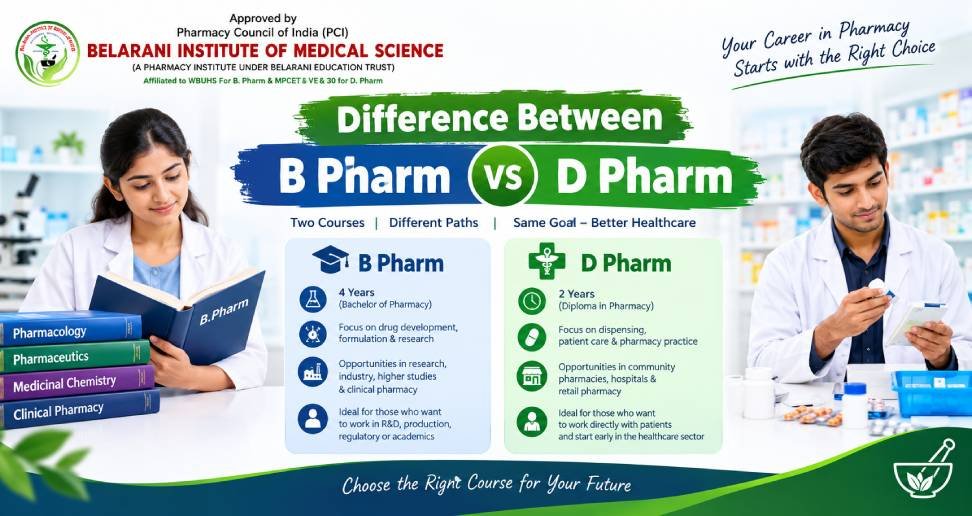
Choosing the right pharmacy course is an important decision for students who want to build a career in the pharmaceutical and healthcare sector. In India, B Pharm (Bachelor of Pharmacy) and D Pharm (Diploma in Pharmacy) are two popular options for students interested in pharmacy. Although both courses provide knowledge about medicines, drug handling, and pharmaceutical practices, they differ in terms of duration, eligibility, curriculum, career opportunities, and higher education options.
Understanding the difference between B Pharm and D Pharm can help students choose a course according to their career goals, academic interests, and future plans.
What Is D Pharm?
D Pharm, or Diploma in Pharmacy, is a diploma-level pharmacy course designed to provide students with basic and practical knowledge of pharmaceutical sciences. The course generally focuses on medicines, their preparation, dispensing, storage, dosage forms, and safe use.
The D Pharm program is comparatively shorter and can be suitable for students who want to enter the pharmacy profession sooner. After completing the required course and practical training, eligible students can pursue registration as a pharmacist according to the applicable rules and requirements.
The curriculum usually includes subjects related to pharmaceutics, pharmaceutical chemistry, pharmacology, pharmacognosy, and pharmacy practice.
What Is B Pharm?
B Pharm, or Bachelor of Pharmacy, is an undergraduate degree program that provides broader and more detailed education in pharmaceutical sciences. It covers both theoretical concepts and practical applications related to medicines and the pharmaceutical industry.
During the course, students may study areas such as pharmaceutical chemistry, pharmaceutics, pharmacology, pharmacognosy, biochemistry, microbiology, pharmaceutical analysis, and industrial pharmacy.
B Pharm is generally preferred by students who want to develop a broader understanding of pharmacy and explore career opportunities in pharmaceutical companies, research, quality control, production, regulatory affairs, clinical research, and other related fields.
Difference Between B Pharm and D Pharm
The most important differences between B Pharm and D Pharm can be understood by comparing their duration, level of education, curriculum, career opportunities, and further study options.
1. Course Duration
One of the major differences is the duration of the programs.
D Pharm is generally a two-year diploma program, followed by the practical training requirements prescribed under the applicable regulations.
B Pharm is generally a four-year undergraduate degree program.
Therefore, D Pharm can allow students to complete their formal pharmacy education in less time, while B Pharm provides a longer and more comprehensive undergraduate education.
2. Educational Level
D Pharm is a diploma-level qualification, whereas B Pharm is a bachelor’s degree.
A bachelor’s degree generally provides broader academic exposure and may offer access to a wider range of higher education and professional pathways.
3. Eligibility
Eligibility requirements can vary depending on the institution and applicable regulations.
Generally, students seeking admission to D Pharm or B Pharm need to complete the required senior secondary education with relevant science subjects. Students should check the current admission requirements of the college or university before applying.
Some institutions may also have entrance examinations, minimum percentage requirements, or other admission conditions.
4. Curriculum
D Pharm focuses on fundamental pharmacy concepts and practical skills needed for pharmacy practice.
B Pharm covers pharmacy in greater depth and includes a wider range of subjects. Students may learn about drug formulation, pharmaceutical manufacturing, drug action, medicinal chemistry, pharmaceutical analysis, quality control, and other areas.
Because of its longer duration, B Pharm usually provides more extensive exposure to pharmaceutical science and industry-related concepts.
5. Career Opportunities
After D Pharm, students can explore pharmacy-related roles, subject to the required registration and applicable regulations. A common career pathway is working as a registered pharmacist in settings such as retail pharmacies, hospitals, and healthcare organizations.
B Pharm graduates can explore pharmacist roles as well as opportunities in areas such as:
- Pharmaceutical manufacturing
- Quality assurance
- Quality control
- Drug regulatory affairs
- Clinical research
- Medical information
- Pharmaceutical sales and marketing
- Drug testing laboratories
- Production
- Research and development
The actual eligibility for a particular position depends on the employer, role, and applicable regulations.
6. Higher Education Opportunities
Another important difference between B Pharm and D Pharm is the range of higher education opportunities available after completing each program.
D Pharm graduates may pursue B Pharm through applicable lateral-entry pathways where permitted by the relevant institution and regulations. This can allow students to continue their education toward a bachelor’s degree.
B Pharm graduates can pursue advanced studies such as M Pharm in suitable specializations. Depending on their academic background and eligibility, they may also consider other postgraduate programs, professional certifications, research opportunities, or management studies.
7. Practical and Industry Exposure
Both programs include practical learning, but the depth and scope can differ.
D Pharm generally emphasizes practical pharmacy skills such as dispensing, medicine handling, dosage forms, and pharmacy practice.
B Pharm usually provides broader laboratory and industry-oriented exposure. Students may work with pharmaceutical analysis, formulation development, quality testing, manufacturing processes, and other areas depending on their institution.
B Pharm vs D Pharm: Which Course Is Suitable?
There is no single course that is suitable for every student. The right option depends on individual career plans.
D Pharm may be considered by students who:
- Want a shorter pharmacy qualification.
- Are interested in entering pharmacy practice sooner.
- Want to develop foundational knowledge of medicines and dispensing.
- May plan to continue toward a bachelor’s degree later.
B Pharm may be considered by students who:
- Want a full undergraduate degree in pharmacy.
- Are interested in the pharmaceutical industry.
- Want broader career options within pharmaceutical sciences.
- Plan to pursue postgraduate education such as M Pharm.
- Are interested in research, quality control, production, regulatory affairs, or clinical research.
Career Scope After D Pharm and B Pharm
The pharmaceutical sector includes many different areas, including manufacturing, healthcare, research, distribution, quality management, and regulatory activities.
D Pharm graduates who meet the applicable registration requirements can pursue pharmacist-related opportunities. B Pharm graduates may have access to a wider range of positions because of their undergraduate-level education and broader academic training.
However, career growth depends on several factors, including practical skills, additional qualifications, work experience, communication skills, specialization, and the requirements of individual employers.
Conclusion
Understanding the difference between B Pharm and D Pharm is important before selecting a pharmacy course. D Pharm is a shorter diploma-level program that focuses on fundamental pharmacy knowledge and practical pharmacy skills. B Pharm is a four-year undergraduate degree that provides broader and more detailed education in pharmaceutical sciences.
Students who want a shorter route into pharmacy-related practice may consider D Pharm, while those looking for broader academic and career opportunities in pharmaceutical sciences may consider B Pharm.
Before taking admission, students should carefully check the latest eligibility criteria, course structure, recognition status, registration requirements, and admission rules of the institution and relevant regulatory authorities. Making a decision based on long-term career goals can help students choose the pharmacy pathway that best matches their interests.